Managing your child's pain
Pain management has many benefits, including a quicker recovery! Overall, your child will feel more comfortable during healing. Unrelieved pain can cause anxiety, irritability and problems with eating and sleeping, which can slow healing and disrupt treatment. However, the total absence of pain is often unrealistic and not always achievable. Keeping your child comfortable allows your child’s energy to be used for healing and recovery instead of dealing with pain. You, along with your doctor or the Pediatric Pain Service, will decide which method of pain management is best for your child.
Measuring pain
Never assume doctors or nurses know your child is in pain. No one knows your child as well as you do, so it is important to help your child communicate to the staff how he or she feels before the pain becomes too severe. You can expect health professionals to respond quickly to reports of pain. If your child is an infant or nonverbal, the nurse will look at behaviors like crying, movement, agitation, body language and vital signs to gauge the level of pain. Your child may be asked to rate pain using the six faces scale. Each face shows a different level of discomfort and your child points to the face that best shows how he or she feels.

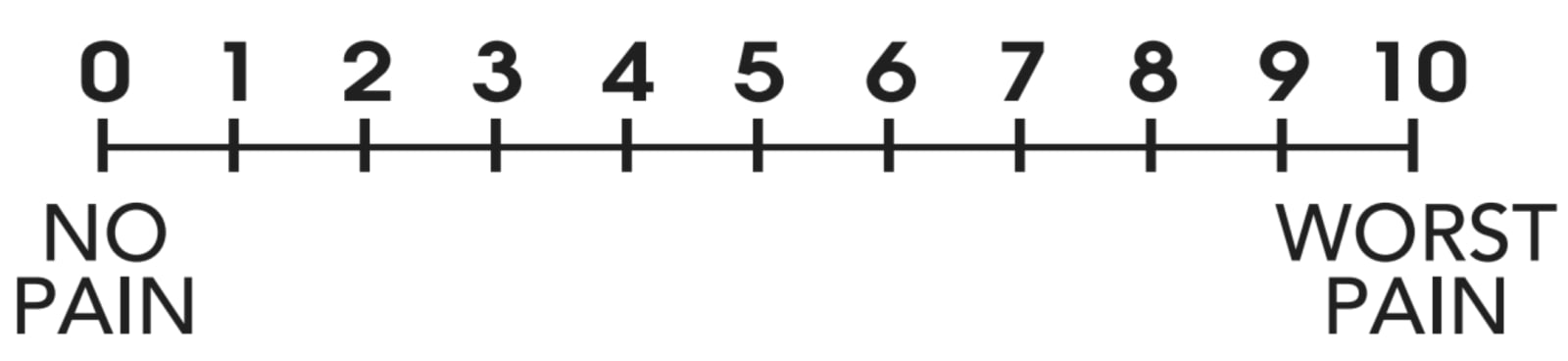
Your child may be asked to rate the level of pain on a scale of 0–10. Zero means there is not pain at all. Ten means it is the worst pain imaginable.
Pain relief without medicine
- Children feel more secure when parents are present. Being loving and caring are comforting ways to support your child in pain. Cuddling, rocking and using a pacifier can also provide comfort.
- Distraction shifts attention from the pain to something more pleasant. Some forms of distraction are television, movies, games, music, blowing bubbles, pop-up books and being read to. Other soothing items for young children can be found in the Comfort Corner in the Walgreens Pharmacy (Pavilion).
- Deep breathing increases relaxation and eases pain. Have your child “blow the pain away.”
- Imagine a favorite place or event to take the focus off the pain.
- Contact your Child Life specialist for additional ideas and resources.
- It is important for patients to continue normal, enjoyable activities to the extent possible while in the hospital.
These methods alone are usually not enough for strong pain, so medicine may be necessary.
Pain relief with medicine
- Pain medicine can be given by mouth in pill or liquid form, by rectum (suppositories) or through the skin.
- A constant level of pain medication can be given through an IV.
- Patient-controlled analgesia (PCA) is another way pain medicine can be given through an IV. With PCA, your child can push a button to receive an additional preset amount of pain medicine as needed.
- Epidural infusion is a pain management method usually reserved for severe pain, such as after major surgery, and is started while in the operating room. The epidural delivers pain medication to the nerve roots in the spine and blocks post-operative pain.
Going home
You will be given information on how to care for your child’s pain at home. Medications used appropriately are very safe and effective and addiction is not a concern with short-term use. Ask your doctor or nurse if you have any questions about your child’s medication.